
Custom Brass Jewelry for Sensitive-Skin Collections
Sensitive-skin shoppers rarely read a spec sheet, but the buyer who serves them has to. On brass, the contact surface is the coating, not the alloy, and the published position is a plating free of lead, cadmium and nickel that is 100% compliant with REACH and CA Prop 65. That claim, plus a 100-piece MOQ per design, is the starting point for a low-irritation range.

Key takeaways
- Contact happens at the coating, so the finish specification matters more than the alloy name on the label.
- Published plating is free of lead, cadmium and nickel and 100% compliant with REACH and CA Prop 65.
- Brass MOQ is 100 pieces per design; stainless steel, published as medical-grade hypoallergenic, starts at 100+.
- ISO 9001:2015 and a BSCI audit cover the process and labour sides of the same claim.
What “sensitive skin” changes in a specification
A reaction is usually a contact event, not a material label. The metal that touches skin is whatever sits on the outside of the piece: the plating, the e-coating, the ear wire, the clasp, the inside of a band. A brass pendant on a long chain may never touch skin at all, while a brass earring post touches it continuously. Those two products need different specifications even though they share an alloy.
The first practical step is therefore a contact map. List every point where the finished piece meets skin, then name the material and the finish at each point. On a ring that is the whole inner band. On a hoop it is the post and the hinge. On a necklace it is often only the clasp. Writing that map down changes which pieces in a range need a barrier coating and which can be left with a standard finish.
The second step is to separate two different promises. “Nickel-free plating” is a statement about the coating chemistry. “Suitable for sensitive skin” is a statement about the finished product in use, and it depends on coverage, fit and wear time as much as on chemistry. A buyer who conflates the two ends up making a claim the product cannot support over a season of daily wear.
The compliance stack behind a claim
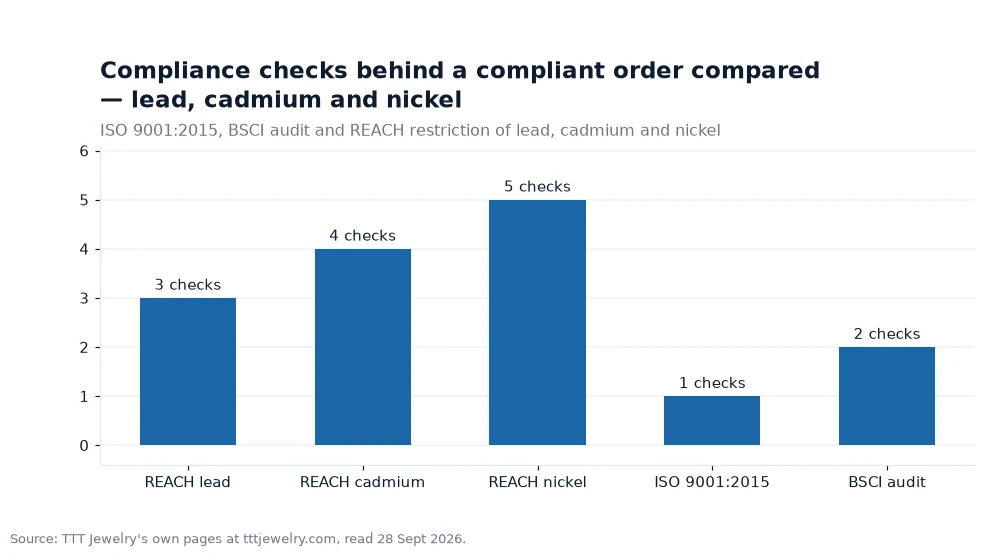
Four published standards do most of the work, and each one answers a different question. REACH covers the restricted substances in the plating. CA Prop 65 covers the California disclosure route. ISO 9001:2015 covers whether the process that produced the coating is controlled and repeatable. BSCI covers the labour and social audit side, which matters to retailers sourcing under their own brand.
| Standard | What it covers | Where it lands in production |
|---|---|---|
| ISO 9001:2015 | Quality management across all stages | Documented process from CAD to final QC |
| BSCI audit | Labour and social compliance | Factory-level, before any order is placed |
| REACH — lead | Restricted substance limit in the finish | Plating bath and incoming material control |
| REACH — cadmium | Restricted substance limit in the finish | Plating bath and incoming material control |
| REACH — nickel | Restricted release from skin-contact parts | Posts, clasps and inner bands |
| CA Prop 65 | California disclosure and limits | Plating and final packing documentation |
The table is not a marketing checklist. Each row corresponds to a question a retailer's compliance team will ask in a different format, and the answers need to line up. A supplier that can quote REACH but cannot describe how the bath is controlled is answering only half of the question.
Design choices that reduce contact
Several design decisions lower skin exposure without changing the alloy. A closed-back earring keeps the post from pressing against the back of the lobe. A wider band spreads pressure and reduces the rubbing that breaks down any coating. A pendant on a coated chain keeps brass away from the neck entirely. None of these are plating decisions, and all of them are simpler than reformulating a finish.
Ear wires deserve their own line in the brief. Posts and hooks are the highest-contact parts of any brass collection, and they are also the smallest. Published customisation covers chains and findings, so a buyer can specify a stainless post on a brass drop, or a coated brass post where the look demands it and the wear time is short.
Where the brief calls for daily wear, pierced styles and shower use, 316L stainless steel is the published answer: 2–3% molybdenum, waterproof, shower-safe and swim-proof, and described as medical-grade hypoallergenic. It takes PVD vacuum plating rather than an electroplated gold stack, which is a different process and a different approval standard, and the stainless steel jewelry manufacturer page sets out the 100+ minimum that goes with it. A brand splitting a range between brass and stainless should expect two sample approvals, not one.
Ordering a low-irritation range
Start with the pieces that touch skin and work outward. In most ranges that means earrings first, then rings, then bracelets, then pendants. The order matters because the highest-contact pieces justify the most specification effort, and effort spent on a pendant that sits on a coated chain is effort misallocated.
The MOQ shapes the plan. Brass runs at 100 pieces per design, and that number covers one design in one finish, so a four-piece earring story in two finishes is eight design-finish combinations rather than four. A custom brass jewelry OEM programme can build the barrier into the first master; adding it after approval means stripping, re-polishing and re-plating, which is a second pass through the coating stage rather than a tweak.
Ask for the master to be approved on the geometry that will touch skin. A gold tone approved on a flat coupon says nothing about how the coating covers the inside of a band, where deposition is least uniform. The inside curve is the part the customer feels.
Worked example
Build a six-design capsule split across two metals. Three brass designs at 100 pieces each give 3 × 100 = 300 pieces. Three stainless designs at the 100+ floor give at least 3 × 100 = 300 pieces, so the capsule commits 600 pieces before any size split.
Run the three brass designs in silver instead and that half of the commitment falls to 3 × 50 = 150 pieces, because 50/100 = 50% of the brass threshold. The calendar does not move with it: 2 days of CAD, 25–30 days of sampling and 21–28 days of bulk still add to 48–60 days.
Now look at the design step as a share of the sampling window. At 48 hours against 25 days, CAD is 2/25 = 8% of the wait; stretch the sample to 30 days and the share slips to 2/30 = 6.7%. The sample is where the schedule lives, so the sensible place to spend extra review time is the master, not the file.
Frequently asked questions
Is brass suitable for sensitive skin?
Brass works when the contact surface is coated: the published route pairs multi-layer plating with an anti-tarnish e-coating and keeps the finish free of lead, cadmium and nickel.
Which metal suits pierced styles for sensitive skin?
316L stainless steel is published as medical-grade hypoallergenic and waterproof, while brass depends on its coating barrier, so pierced styles often move to stainless.
What documentation should a buyer request?
Ask for the REACH and CA Prop 65 position on plating, the ISO 9001:2015 scope, the BSCI audit summary and the lot-level inspection record.
Where to place the brass in a range
Put brass where the shape is the selling point and skin contact is limited: statement earrings with stainless posts, cuffs, pendants on coated chains, and rings that are not worn continuously. Keep the daily-wear basics in a metal whose published properties already answer the sensitive-skin question, so packaging copy can carry a specific statement per piece instead of one vague claim across the collection. The TTT Jewelry factory pages set out the certifications behind both routes, from ISO 9001:2015 to the REACH position on plating. None of this replaces a legal review of the claim a brand intends to print, but it makes that review shorter because the specification and the evidence trail are already written down.
Source note: figures come from the manufacturer's own website (tttjewelry.com), read 28 Sept 2026.[1]