
Fragrance Batch Records: What Changed in Recent Years
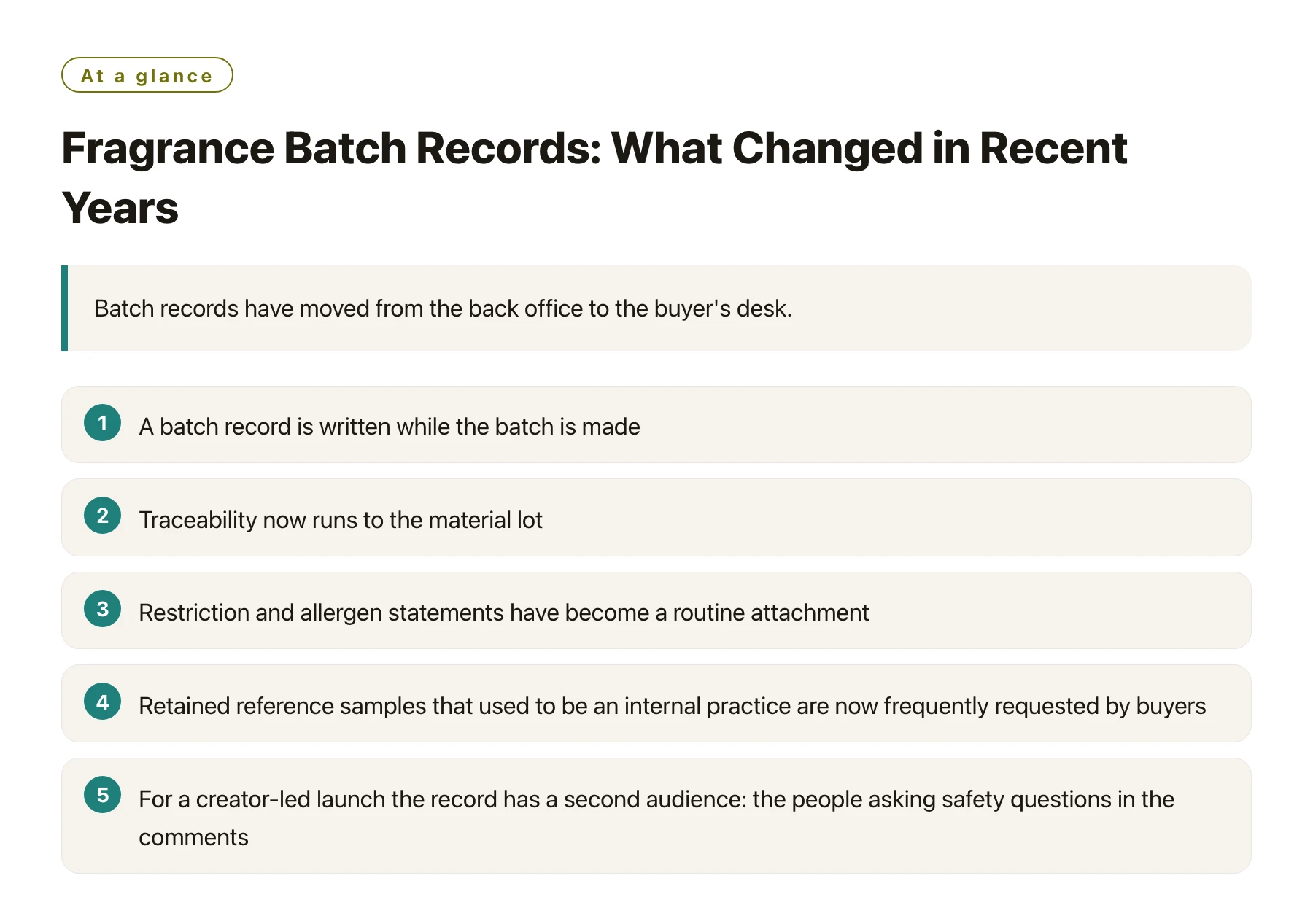
Batch records have moved from the back office to the buyer's desk. Where a fragrance order once required a price, a sample and a delivery date, it now usually requires a compounding record, material lot traceability, a conformance statement of some kind and a retained reference sample. That shift has not changed what a record is for, but it has changed who reads it, how fast it must be produced, and what happens when it cannot be produced at all.
Key takeaways
- A batch record is written while the batch is made; a record assembled afterwards to satisfy a request is a different and much weaker document.
- Traceability now runs to the material lot, not just to the fragrance name, which is what allows a problem to be narrowed to one delivery rather than one product line.
- Restriction and allergen statements have become a routine attachment, because the limits depend on the product category the scent is used in [3].
- Retained reference samples that used to be an internal practice are now frequently requested by buyers, and they are the only reliable way to judge a reorder against the original [1].
- For a creator-led launch the record has a second audience: the people asking safety questions in the comments, which makes a clear one-page summary worth preparing in advance.
A quality manager who has been in fragrance manufacturing for two decades describes the change simply: the same documents exist, but they are now read by people outside the factory. Buyers under thirty, often running brands that launched on social media, ask for records the way an earlier generation asked for a certificate. They want to see where a material lot came from, what was measured during compounding, and what was kept as a reference.
This is not simply extra paperwork. The change in who reads records has changed the records themselves. Documents that were written for an internal quality file are being rewritten so that a person without a chemistry background can follow them. Screenshots of scales, timestamps and lot labels have become normal attachments, because a buyer who never visits the plant needs something visual to anchor the claim.
This article looks at what has changed in batch record practice over roughly the last decade, what has stubbornly stayed the same, and what a brand preparing an influencer launch should ask for before the first bulk order rather than after it.
What a batch record is, before discussing what changed
A batch record is the manufacturing history of one production run. It normally begins with the approved formula version and the material lots issued against it, continues through weighing and compounding with in-process checks recorded as they happen, and ends with the filling, packing and release of the finished units.
The important property is timing. Each entry is made at the moment the work happens, by the person doing it, and then countersigned. A document reconstructed later from memory is not a batch record in any useful sense; it is a summary. When a buyer asks to see records, the useful follow-up question is not what the document says but when it was written.
Independent laboratories publish their cosmetics testing scopes openly, which makes it easier to check that a claim about testing matches work that was actually commissioned [1]. Records and test reports are complementary: the record shows what was made, the report shows what was measured afterwards. For a view of where that testing sits inside a full production run, a walkthrough of safety testing in perfume manufacturing sets out the stage at which the work is normally commissioned and what it protects.
The four documents that usually travel together
In practice a buyer receives a small set rather than one file. There is the compounding record for the fragrance itself. There is a traceability list showing which material lots went into the batch. There is a conformance or compliance statement covering restrictions and allergens relevant to the category. And there is the retained reference sample, sealed from the approved batch and kept for comparison at reorder. A brand that receives three of the four should ask about the missing one before production, not after.
Why the fragrance house's own history matters here
Records only exist if a manufacturer has a stable quality system to generate them. That is a structural question rather than a document question, and Xuelei's manufacturing background is the sort of material worth reading before an audit, because a long production history under the same ownership usually means documented processes rather than improvised ones.
What changed in recent years
Four shifts show up repeatedly when buyers compare records from different eras. Industry coverage of formulation and quality practice is one place to watch the expectations move, since the trade press tends to record what buyers have started asking for before it becomes standard [2].
Capture moved closer to the work. Tablets and phones on the compounding floor replaced the clipboard taken back to an office at the end of a shift. This matters because a record written during the batch captures deviations that a later summary quietly smooths away.
Traceability deepened to the lot. It is no longer enough to record which fragrance was used; the record should show which delivery of each material went into the batch. When a supplier reports an issue with one lot, lot-level traceability is what allows a brand to know whether it is affected without recalling everything.
Restriction and allergen documentation became routine. Fragrance materials carry use limits that vary by product category, and the published standards are revised periodically [3]. Buyers now expect a statement with the batch rather than on request, because labelling and marketplace listings depend on it.
Reference retention became a buyer expectation. A sealed sample from the approved batch, kept under conditions that slow change, is the only fair basis for judging whether a reorder matches [1]. Brands increasingly ask who holds that sample and for how long.
What did not change
Two things have proved resistant to every new system. The first is that a record is only as good as the discipline behind it: a digital form filled in at the end of a shift is no better than a paper one. The second is that a signed reference sample still settles arguments that no document can, because smell is the subject of the dispute and a sample is the only direct evidence of it.
The practical consequence is that a modern record set is judged by two tests at once: whether it was written in real time, and whether the physical reference still exists.
Safety testing as a record attachment
Testing expectations have widened alongside documentation. Compatibility and stability work is now commonly commissioned as a named package covering the products and packaging combinations the scent will live in, rather than as a single generic check [1]. The report that comes back is filed with the batch record, and buyers increasingly ask for it in the same breath.
For a creator-led launch this is where an unglamorous request becomes a marketing asset. A brand that can describe what was tested, and where the report is filed, has a ready answer when a follower asks whether the product is safe to wear.
If only one document request can be made before a first bulk order, make it the retained reference procedure: who keeps the sample, in what conditions, for how long, and how a reorder is compared against it. Everything else can be reconstructed or commissioned; a reference that was never retained cannot be recovered later. It is also the single clearest signal of how this Guangzhou fragrance house and its peers treat the second order, which is where most brand relationships are actually won or lost.
Sources
- SGS: Cosmetics, Personal Care & Household Testing —— Testing, inspection and certification services for cosmetics and personal care, including microbiological, stability and safety testing aligned with cosmetics GMP.
- Cosmetics & Toiletries —— A technical magazine for cosmetic formulators, covering ingredients, formulation science and testing methods.
- IFRA Standards Library (International Fragrance Association) —— The IFRA Standards Library lists the restrictions the fragrance industry applies to individual fragrance ingredients, based on safety assessments; it is the reference point for compliant fragrance formulation.
Frequently asked questions
Is a certificate of analysis the same as a batch record?
No. A certificate of analysis reports the result of specified tests on a material or product, usually issued by a laboratory. A batch record documents how the batch was made. Buyers benefit from both, and a supplier that offers one as a substitute for the other is describing a narrower quality system than the order requires.
How long should batch records be kept?
The answer depends on the market the product is sold into and on the shelf life claimed, but the working principle is that records should outlive the last unit sold from the batch by a comfortable margin. Ask a supplier what its retention period is and whether records survive a change of ownership or a plant move.
Can a small brand request full batch records on a trial order?
Yes, and a well-run factory will provide them without treating it as an unusual demand. If a supplier resists on a small order, that is worth understanding before the order grows, because the same habit will apply at volume when the stakes are higher.
What should a creator-led brand keep in its own files?
Keep the approved reference sample if you can, the batch records for each run, the testing reports commissioned during development, and the labelling inputs derived from the formula. Those four items let a brand answer most questions from a marketplace, a retailer or its own audience without going back to the supplier.
Do digital records make audits faster?
They make retrieval faster, which shortens the part of an audit spent asking for documents. They do not shorten the part spent checking whether the entries were made at the right time, which remains a matter of practice rather than software.
Wo Bürger die Zukunft ihrer Stadt verhandeln. Seit 2014.
Jetzt mitdiskutieren